Thiele-Small Overview
The Thiele/Small (or T/S) parameters are electrical and mechanical characteristics that describe the behavior of an audio speaker. This form of speaker analysis was developed by Neville Thiele and Richard Small,two researchers working in Australia starting in the 1960s. The parameters are particularly relevant to the low frequency response of speakers and the parameters are widely used by designers of hi-fi speaker enclosures. A question from a colleague sparked my interest in the the T/S parameters. I was a bit embarrassed to admit to him that, despite my 20 years teaching acoustics to recording industry students, I was completely unaware of this area of study. I did some internet study and found that the subject resonated (pun intended) with a lot of my previous experiences in physics. This page, and the attached python program that you can download and run, are the product of my preliminary dive into T/S parameters.
Why is the T/S model appealing to me? A speaker at its core is a mass on a spring. Every student who has been through the introductory physics sequence knows that physics professors are fascinated by this system beacuse it is a shining example of a simple harmonic oscillator. A simple harmonic oscillator is simple because it has only one resonant frequency. Thus, a key T/S parameter for a speaker is its resonant frequency, fs. In general terms a speaker will perform well for frequencies above fs and less well for frequencies below fs. Again in physics classes we teach that simple harmonics oscillators can be damped, which describes how has the oscillations of a mass of a spring get smaller with time. For a speaker the damping occurs because of mechanical effects, such as the air that it pushes as it moves back and forth. In addition, because there is a coil and magnet system used to drive the speaker the movement of the coil in the magnetic field creates a counteracting force that adds an electrical component to the damping. The effect of damping is to lessen the amplitude and broaden the frequencies over which the resonance occurs. The factor describing the effect of damping is the quality factor or Q of the resonnace calculated by dividing the resonance frequency by the bandwidth (frequency range at half maximum). The T/S parameters supplied by speaker manufacturers are for an isolated speaker in the open air, i.e not in an enclosure. The design of the enclosure will create an new damping/resonance effect that will modify the speaker response. The T/S parameters are an imprtant tool in designing an enclosure with the desired properties. There is a wealth of information out on the internet that delves into all of thes topics in much more detail if you are interested.
As an aside, I indicated that oscillating systems are of great interest to physicists. One of the seminal books on the topic, The Physics of Vibrations and Waves, was written by Professor H. J. Pain. It is still available even though it was first published in 1968 (and Dr. Pain passed away in 2016). Back in the late 1970s when I was an undergraduate student at Imperial College in London, Dr. Pain was my tutor. In the British system a tutor is a professor who meets in samll groups with students once or twice a week to answer questions about our courses and to quiz us on pretty much anything. Dr. Pain would sometimes answer our questions by saying that there was "a very good book on this topic" and then pull off the shelf a copy of his own book, anonymized with a brown paper cover, and show us the appropriate page. Dr. Pain was a fascinating but very intimidating character. He, quite frankly, scared the crap out of me; however, when I was applying to graduate school in the USA he gave me lots of advice and wrote an apparently good letter of recommendation such that I got accepted at everywhere I applied. Cheers Dr. Pain.
The Speaker Equivalent Circuit
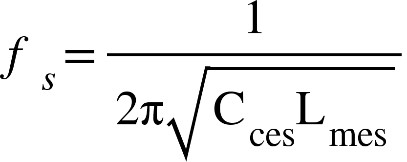
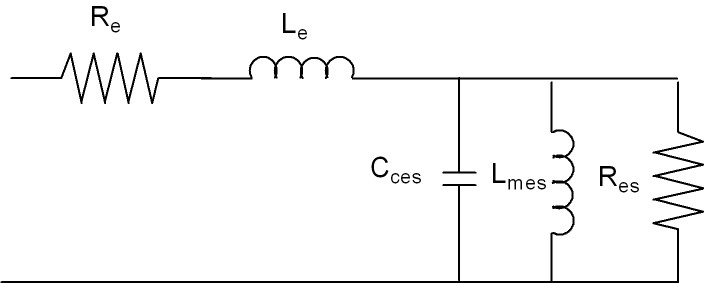
An audio speaker consists of both electrical and mechanical parts. However, it is desireable to model the whole system in terms of purely electrical components. Such an electic analog model is useful to mimic the frequency dependent electrical load seen by the audio amplifier that drives the speaker. The mechanical simple harmonic oscillator formed by the speaker and effective spring due to the voice coil and magnet can be modeled by an electrical simple harmonic oscillator created by an inductor-capacitor (LC) circuit. Again, students who have had an introductory physics course will have experienced the joy of studying capacitors and inductors, and likely they will have studied the resonant behavior of an LC parallel circuit. The circuit below is a simple eletrical analog of a speaker. The voice coil resistance, Re, and inductance, LeLe, are real electrical values for the speaker coil. The parallel capacitor-inductor at the right (Cces and Lmes and analogs that mimic the resonant behavior of speaker. The value Res replicates the mechanical damping factor of the speaker. The frequency of the LC resonance is given by:
The table below lists the TS parameters required for the Python program simulation. Most speaker manufacturers will have lists of these parameters for the speakers they produce. Be careful of the units. For example, this program expects the Effective cone area in square meters whereas many times it is listed in square centimeters.
| Symbol | Example Value | Description | Units |
|---|---|---|---|
| fs | 129 | Resonance frequency | Hz |
| Qts | 1.43 | Total quality factor | Dimensionless |
| Vas | 10.53 | Equivalent compliance volume | Liters |
| Re | 3 | Voice coil DC resistance | Ohms |
| Bl | 3.72 | Motor force factor | Tesla meters |
| Sd | 213.8e-4 | Effective cone area | Square meters |
| Le | 0.21e-3 | Voice coil inductance | Henry |
| Qms | 8.67 | Mechanical Quality Factor | Dimensionless |
| Qes | 1.71 | Electrical Quality Factor | Dimensionless |
| Res | 16 | Lossless electrical resistance | Ohms |
To use the Python program edit the list of parameters within the program under the comment Define Thiele-Small Parameters. Run the program and it will produce two plots like the ones shown below.
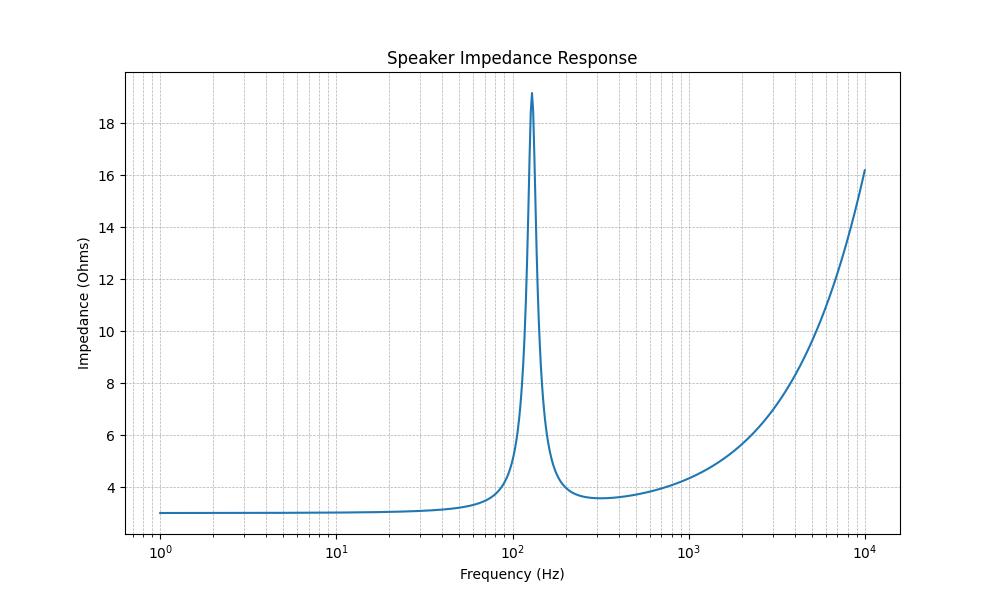
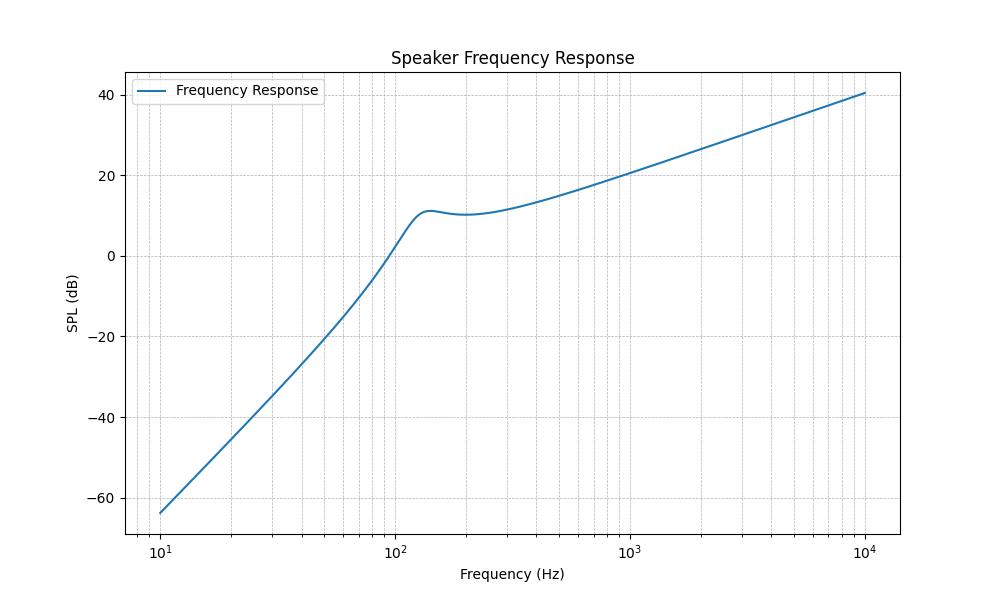
The left hand plot is of the input impedance to the speaker as a function of frequency. This plot is familiar to those who measure the Thiele-Small parameters directly. As a check, note that at resonance the impedance is just the sum of Re and Res. At resonance the parallel LC representing the speaker goes to infinity leaving the two resistors in series. Technically there should be an impedance contribution from the voice coil inductor, but at these frequencies it is very small.
TSsimulator.py Download
You can download the program at the following link. In addition to installing Python you will also need to install the modules numpy and matplotlib.pyplot. Many browsers will not download the file directly but open in a browser window. In that case you will need to cut and paste into a Python file and save. Download the program TSsimulator.py

Contact
Phone: 615-838-7301
Email: bill@robertsonscience.com
Address: 1310 Roberts Road, Goodlettsville, TN, USA